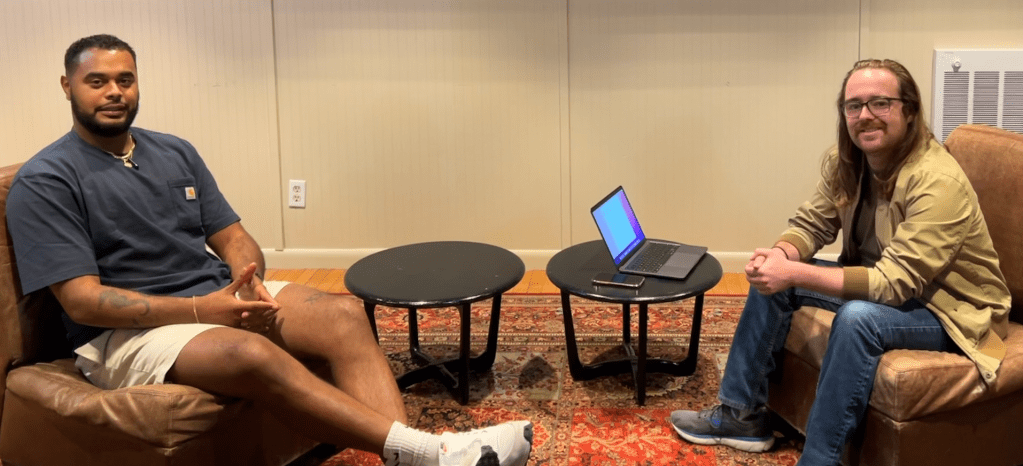
I was joined by Diamonté Zarba at The Studio Around the Corner in Brewster, NY to talk about artificial intelligence, the butterfly effect, and his political aspirations.
Frankie Becerra: Thank you for being here.
Diamonté Zarba: Thank you for having me.
FB: I’m very happy to have you involved with the project, so if it’s ok with you to just roll right in to some of the questions I’ve got ready for you?
DZ: Yep.
FB: What’s one way that you’ve changed since high school?
DZ: I’ve become a lot more patient in my approach to things. You have a really shortsighted approach when you’re in high school to business- well not business at that time, but whatever it is that you enjoy you have a shortsighted approach to, and over the last year, two, maybe even three years, you’re still growing as you get older, I’ve reached the point of patience and trusting the process and that’s been the biggest thing since high school that’s really changed.
FB: I agree it’s one of those things where it’s like when you’re at that age it’s hard to kind of see what else is going on because high school really is your entire world.
DZ: That’s it, that’s all you know. Even with sports and even with high school relationships or whatever it is you’re doing, it’s still based off of high school so that’s all you know. When you get out into the real world, even past college, is when you’re still realizing who you are and how you can develop and patience. I’ve had some of the deals that I’ve worked on in real estate, which we can talk about later, some of the biggest deals I’ve worked on have taken years to really put together, so seeing that come together has been patience.
FB: Well that does kind of lead into the next question nicely, what’s one thing you’ve accomplished in the last ten years that you’re proud of?
DZ: I partnered with a $150million company from Switzerland to NFT for the first time in history a luxury watch. It was a one of three Kobe Bryant signed Hublot watch. I partnered with the company, ehh, I won’t share their name and give them free publicity, but that took us to over 300 publications around the world. About 250million eyes saw my project, including being featured in the Nasdaq in Times Square, twice actually. So that was cool to not only be a part of but lead as well, between myself and the CEO of the company we were the two point-men. That was exciting. Since then I bought some property, I’m in contract right now for 130 units in Cleveland, so things have been good since high school.
FB: Good, I’m glad. Now with that in mind what’s something you hope to accomplish in the next ten years?
DZ: A family… definitely a family. I’ve reached the stage now where I’ve planted the seeds professionally, but watering them, I think that will take a partnership to really water so I’m looking forward to the next steps with my current partner and moving forward and solidifying my family name.
FB: Nice, I like that. So what, if anything, do you miss most about high school? And it’s ok if the answer is nothing.
DZ: I miss- so we have to, we should really at some point discuss because high school for me at Brewster was a little different because, I don’t know if you even knew this, I was a fifth-year senior.
FB: I did know that, yes.
DZ: So my experience was I was in Brewster High School for three hours a day (laughs). I would get in at fourth period, leave by like seventh, or third period leave by sixth or seventh. So I miss… I don’t want to say how innocent I was, how life was a lot different. The way you just saw the world, life. And not to be that guy, not to mention it, but being a Black man in America even day to day I have certain anxieties being outside because of society. I don’t ever play the Black card, but I remember being in high school and the only concern was you got home from the bus or got home from whatever it is you were doing that day or whatever it was so I wouldn’t say (being) more innocent, but things were a lot different in high school.
FB: Yeah and I think that it’s a completely valid thing for you to bring up because there is kind of the safety net that exists in high school and childhood, and obviously that’s taken from all of us to a certain extent, but of course there is a different experience for everyone.
DZ: Yeah, so I think the biggest day that really woke me up was, so I read the newspaper a lot, not as much now because it’s as biased as it is, but back then I realized that when someone’s 17 and they’re in the news it’s “teenager… whatever”. As soon as you’re 18 it says “18 year old man convicted of crime”. And so in that situation I realized alright well as soon as I walk out the door after my graduation and my diploma’s in my hand, I’m a Black man in America. So that is the experience that I have to walk around with everyday and that’s just, you know something to keep in mind. My brother is 19 now, he’s the starting tight end at UCONN, but I’m watching him have that same challenge accepting that I’m watching from afar, but close as well to… that’s tough. It’s tough especially because this is the age, or that’s the age from 18 to 25, 18 to 26 where people end up in jail, people end up in things that- you know life really happens in that timeframe so I’m able to have gotten through that and you know hoping that it’s smooth sailing on the way out.
FB: I hope so. Do you think you left high school prepared for the next phase of your life?
DZ: No. I think Brewster High School specifically… I think some of the skills we developed are not as applicable as they should be. Personal finance classes, real health classes, some of the things that you realize in a day to day world are what you actually deal with I think should have been taught better. Even if they’re not in an actual class, they’re in a club or an after school program, it should be an option. There should also be more opportunity for speakers to come in and speak to those clubs. So someone who’s in your career field coming back to speak to the class or the grade. I think that, especially in a small town it’s kind of like if you don’t know what you’re gonna do by now, good luck… if you don’t know by late May what school you’re going to, or what job is next, you know we’re hiring kind of thing. And I think that needs to be something that’s worked on as well.
FB: I think it’s interesting that, a couple of things you brought up there, I’ll start with kind of the career aspect of things because this is something that I’ve been thinking about a lot recently. We are kind of brought up in this world where we’re told “You can be anything” and “You can be whatever you want” to an extent, but then you get to a certain age where it’s like “So, what did you pick?”
DZ: (Laughs)
FB: “Which of the things did you choose?”
DZ: “Oh you didn’t pick anything? Oh, ok.”
FB: As if you have to just choose your one and then just stay in that lane forever and it’s like “But you told me there was everything I could do”
DZ: And there’s an interesting road to walk there because it’s one part you definitely want to let children and people that are in high school and people as they grow up to have that sense of confidence in the world, but there also needs to be a road to get there as well. Saying I can do anything in the world is great, but how do I do anything in the world? What are the skills that I’m developing? What are the resources being developed? So that was one thing that, even at this age in life, I would love to as part of our program, not our program but our plan in Brewster, maybe we can offer a financial to the community because it’s not gonna get easier. It’s not gonna get better, especially in this AI world. If you don’t have by, you know it used to be 18, 19, 20, if you don’t have skills by 16, 17, 18 good luck. And that’s what I’m really looking to actually start a non-for-profit with one of my partners that’s really geared to providing financial literacy to inner city students. So whether through cryptocurrency, real estate, stocks, learning what’s out there needs to really be a tool because we’re, what, ten years from high school? Pythagorean theorem’s not been used once unfortunately. I still know what it is though (laughs).
FB: That a^2 + b^2 does still = c^2
DZ: (Laughs) I know that! But that’s what I’m looking to change and be the impact in my journey.
FB: That’s one of those things about AI that’s actually kind of bothering me now that it’s been so much more in the conversation recently because growing up when we saw AI in like sci-fi movies and stuff it was always used to make peoples’ lives better so that they didn’t have to do certain things, and now it’s being toted as this thing that’s gonna steal these jobs. Why doesn’t it just take the jobs so that other people don’t have to do those jobs?
DZ: But that’s one thing I’d love to say, that’s the media isn’t it? Because I’m on the side of AI where I’m seeing people make money with it, I’m seeing people use it- I have an app on my phone that has five times my productivity in the last three months. So I’m seeing it myself how it can be beneficial, but if you’re waiting to see how it changes your industry, you’ll get caught in a wave that you’ll never come back from. If you’re figuring out now in advance how to monetize it, how to work with it- there’s a title, that one of my business partners is working on becoming, a prompt engineer. Speaking to ChatGPT is not as simple as like- like my experience with ChatGPT is different than the average guy on the street. It’s the same software, but if you don’t know how to prompt it and how to engineer it, you know, that’s- and that’s something that should be being taught, not the fear of AI. How it could be used as a tool. How we could all benefit from it because it doesn’t seem like it’s going away anytime soon.
FB: Yeah, I agree. It’s definitely only going up from here.
DZ: Oh for sure.
FB: Now if you could change one thing about your time in high school knowing what you know now, what would you change? We’ve kind of taken a look at that with the last couple of questions, but what would you say specifically?
DZ: I would have… So when you ask me the question “in high school” are you referring to Brewster High School or are you referring to a general time or both?
FB: I would say more about your time personally in high school. About your journey, is there something that you would change?
DZ: I would’ve been a lot less hardheaded. I was very headstrong in high school. I was fortunate to have built a pretty good basketball career at that stage prior to social media and all of that, so this is when you had to really earn reputation and experience, so I should’ve kept that mindset a little bit later. So like towards college that would’ve been better, but freshman and sophomore year I should’ve been a lot quieter and learned a lot more. So by junior and senior year, it was kind of just watching something that I had built for years, being basketball, change right in front of my eyes. So any changes I would’ve made back in high school probably would’ve been related to basketball because school, like I said honestly I don’t think there’s anything I would’ve changed differently about the educational experience. It was what it was and it is what it is. But as far as basketball I would change my approach to it and give it more of the respect that it deserved.
FB: Nice, I like that. Now as a member of the Class of 2013, do you have any advice for the current seniors, the Class of 2023, as they enter this next phase of their lives?
DZ: Figure out how to use AI for sure. Figure out how to make everything that’s available to you now a tool. One thing that I wish I’d learned, I was saying this to a business partner friend of mine, video design is such a tool that I wish I, back when it was in its infancy stages I wish I had developed how to, and obviously the tools available and so many apps available anyone can edit video, but really understanding that skill or skills like that you have a foundation because now you can be, whether it’s marketing, whether it’s advertising, whether it’s another foundation up, you are the core foundation. So developing a skill is definitely what I would say to focus on one, three, to five years. And I say one, three, to five years because focus on doing things in longer time intervals. You don’t want to be working on things week to week, month to month, unfortunately, time moves a little faster than that, so I’ve seen things to be on five-year timeframes and breaking that down into an annual timeframe, and then quarterly, and then you can work on your week to week and day to day goals from there.
FB: Yeah that makes sense, and I think the skills aspect is a really important thing for everyone really because it’s very easy to take for granted whether or not you are developing something that is going to help you in the future.
DZ: I would say as well that another thing we kind of miss from high school is, I would argue maybe 70% of our graduating class has not picked up a book since high school. I would say that learning how to learn is also important as well because if you’ve only learned by going to third period and going to fourth period and having homework, no part of you wants to learn, you just learned because you had to. Figure out a skill, figure out something that you can focus on, and channel your learning and whatever it is and however it is that you learn, focus on something because, in this coming world, you’re definitely going to need all the skills you can have and maintain.
FB: So with the current seniors on our mind, do you think that you would rather be a high schooler right now or back in the early 2010s when we were there?
DZ: Oh my god there’s no chance I would be in high school now.
FB: You wouldn’t?
DZ: No I would not. You couldn’t pay me to be in high school today. Between TikTok and designer clothes, I couldn’t imagine prom today. Are you kidding me? How expensive prom would be? Jesus. Nah we were fortunate to have been the last of that like pre-phone generation. I remember my first phone was a Sprint flip phone in sixth grade.
FB: Me too.
DZ: So having that iPhone 11 be your first phone you’re having too much world and access in your hand. And if you’re someone that’s using that as a tool then sure, but if you’re just letting it burn a hole in your pocket it’s gonna be tough graduating this year and moving on to the new generations.
FB: And I think that’s been one of the most common things that’s come up when I’ve asked this question so fas is both the social media aspect and the technology aspect of it all, and I think it’s because the leaps and bounds that we’ve seen in this technology has just been… it’s unimaginable the amount, like granted we had iPhones towards the end of our high school experience-
DZ: Exactly but our brains had already molded by then.
FB: But not even that, they could not do nearly the things that they’re capable of now. Maybe Twitter and Angry Birds.
DZ: (Laughs) Exactly, exactly. Getting the (iPhone) 14 now as a ninth-grader or tenth-grader it’s a lot. Especially with TikTok and the pressure of, you know you ask, and it’s actually a statistic as well if you ask, I’m not gonna quote the exact number because I don’t know, but the generality is the 14-17-year-old generation, like 30%+ of them the job they want to be when they grow up is YouTuber… There needs to be more options available to the people that are coming out (of high school) whether it’s trade, whether it’s a skill, even a digital skill… it’s time for us to be a lot more focused as we come out from especially a small-town high school because unfortunately the experience is not made for you to be someone who is having a large impact on society. It’s meant to be cookie cutter you graduate high school, you get a college degree, whether it’s two-year or four-year, you get a job for 35 years, and that’s that. I think the world’s changing so fast that you need to be light on your toes and pivot as you need to.
FB: I do think, because I’ve heard that statistic as well from a friend of mine who used to be a teacher and he was working with middle schoolers at the time and it was 7th graders that he was asking that question to and he was getting the same kind of results where like close to 40% of them were saying specifically YouTuber.
DZ: Specifically and thats like, and that slash content creator, even the “slash” gives me hope, but YouTube is such a niche that well if everyone is a YouTuber then how is there any value to being a YouTuber? Just like anything else in the world. If everyone does it then how is there any value in it?
FB: I think the reason we’re seeing the levels at which this generation is drawn to YouTube specifically is because, for a lot of them, it’s become what TV was for us.
DZ: That’s a good point. That’s a great point. I never thought about that.
FB: But it’s so much more accessible as a point of entry-
DZ: Anyone could do it
FB: Because any of them could just get up in there.
DZ: That’s a great point (laughs).
FB: I couldn’t send the sketches I was making to All That to try to get on there, you know?
DZ: (Laughs) You’re right, you’re right.
FB: As much as that was my dream when I was a kid, and then Saturday Night Live by the time I was in high school, I couldn’t just send them my stuff and be like “let me know”. But you can throw anything up on YouTube and hope. It just takes one spark up.
DZ: It’s the illusion of accessibility where it seems like because it’s so accessible, why not me? Why can’t I be the one? And there’s definitely a value in that as well, in that confidence, but it’s like well apply that same mindset towards things that maybe have like- like same thing in sports in high school or middle school what do you want to be? A professional athlete. When you look at the numbers, that’s great, but what are other options? If you want to do that, and that’s what it becomes that’s great. More power to you. But let’s make sure there’s other options that you’re prepared for, because the day that you’re no longer picking up a basketball you don’t want to be stuck. That’s one thing I’m very privileged to have had where it’s like, I’ve always kind of had my plan B, C, and D behind me so the day I unfortunately no longer shot a basketball I wasn’t stuck as an athlete… There’s an identity crisis that goes with no longer playing that sport. Especially the further you get the harder it is to let it go just like with anything else… I played college basketball and I remember the day of my last game. I also remember my first game. Now that level of like “Wow, what if I was that just hung onto that, hung onto that dream, never let it go”… I wouldn’t have moved on the way I wanted to, but having those other options allowed me to let it go in harmony and not hold on to something and make it hurt. You know, because holding on to something for too long can make it hurt.
FB: I’ve been going through something really similar to that with comedy lately because I’ve been doing standup for almost ten years now. I started during my freshman year of college-
DZ: Life is fast right (laughs)
FB: You’re tellin me, but it was something that I knew I always wanted to do and it was something that as a kid I kind of had to wait to start doing. Granted I had been writing (jokes) since high school and even middle school, but once I was able to finally get out there I was really loving it for a long time.
DZ: Damn, you were prepared.
FB: Yeah I was prepared. But it also gets to a point where you do kind of have to take a step back and be like “now what?” Because like you said, you remember your last game, but I kind of have to decide when my own last game is to an extent.
DZ: That’s fucking crazy. That’s tough.
FB: So it’s another one of those things too, and it’s like you said with the accessibility of YouTube, you’re also not- with a career like YouTube or like comedy, or even sports to an extent, there’s a luck factor that doesn’t get discussed enough.
DZ: For sure, and timing. Timing and luck are 70% of it I would say. For sure.
FB: And it’s one of those things where it’s like I have a lot of friends that are teachers, I have a couple of friends that just got their doctorates on a medical level, and I have nothing but respect for them of course, but the way that (getting) those jobs are primarily different, at least the way I see them, is that there is a set path and series of steps that you take to become a teacher or to become a doctor, and I’m not saying that those are easy, but I am saying as long as you do A, B, C, and D, and you don’t hit a kid or stab someone, then you will almost definitely be able to become the thing that you set out to be. And in something like comedy, or something like, as we’re calling it today, content creation, you do, in my case the way that I have both had it explained to me and have come to explain it to other people through my own experience is, I remember a lot of people saying you do it (standup) for ten years and then hope for the best.
DZ: Ok, so that’s the timeframe in which you’re working on.
FB: Yeah but what it really comes down to is you keep doing it and hope that at some point you’ll get lucky. And it’s been really weird because I have seen people in our age group reach giant levels of success and different milestones. Like, Pete Davidson got on SNL in my sophomore year of college.
DZ: For what?
FB: That’s just when he got on SNL, that’s when he got hired.
DZ: Pete Davidson was on SNL?
FB: That was his first big thing. And I actually knew of him through a friend that knew him, they grew up together on Staten Island and she told me to check him out-
DZ: So timing and luck are a part of it as well, but what do you think is, in your experience, the differentiating factor from someone that- because I’m sure you’ve met people that you’re funnier than that may be at a different stage in their career. So what do you think are the actual components that may go into that? Or is it just timing, luck, and hope?
FB: I think luck is definitely one of the biggest things, but I think luck manifests in a lot of different ways. Luck is also what you’ve been brought up with. Luck is also who you know. Luck is also the people who are willing to put on for you and willing to say your name in other conversations-
DZ: You’re right, luck isn’t just this part it’s the whole component.
FB: Yeah I think there’s a lot to it that people don’t really (consider), it’s not just finding $100 on the sidewalk, it’s things that you might not even consider. You might not even realize that someone brought you up in a conversation sometime, and that might’ve stuck with someone.
DZ: Holy shit.
FB: And then when a different opportunity arose you were still in that person’s head and they said “what about them?” But it’s also a lot of putting the time in.
DZ: Ok.
FB: I know that because of the life that I’ve had, I haven’t been able to put the time in as much as I would have liked. I’ve had to have certain jobs where I need to be up at 5:30 in the morning, so I couldn’t be out doing open mics until midnight. But there are other people who have had a life where they are able to dedicate their entire life to this craft. I kind of compare it to unpaid internships. I wasn’t able to do unpaid internships in college because I was borderline working full-time while I was in college. So that did hurt me on a resume level when I was applying for jobs afterward-
DZ: Because you didn’t have the same experience level
FB: Exactly because I couldn’t afford to work for free. And it is one of those things where it separates people on a class level very quietly until you realize that’s what it is and then it becomes pretty loud.
DZ: You know what’s really crazy, I didn’t realize that until today. So there’s never a timeframe in which shit’s too soon or too late because I never realized it- you’re right. Luck isn’t just finding $100 on the street it’s what made you on that street, what experiences led to you being on that street. So it’s like when that is compounded on a larger scale it’s like yeah that may have happened to you today, but what happened five years ago that led to that happening to you today?
FB: It’s like that whole thing of like I saw this post about how none of the Kardashians would be famous right now if the (Buffalo) Bills didn’t draft O.J. Simpson.
DZ: Oh shit.
FB: Just because of the way that all of that was connected. Because if he didn’t go to Buffalo, he might not have had that career. And if he didn’t have that career, he might not have had that level of notoriety. And if he didn’t have that level of notoriety, he wouldn’t have been in that situation when the case happened. He wouldn’t have hired Robert Kardashian and then the whole thing becomes a thread. Like a butterfly effect kind of thing
DZ: That’s one of the most interesting things. Another thing I would answer as well, one thing I’ve gotten into since high school is psychology. Every situation I’m in or watching happen I try to, for lack of a better term, disassociate and watch externally, and that is something that I’ve seen as well where like the way things fit into the larger puzzle… It’s more the universe than it is anything else. We may settle it down to luck but it’s the universe and the powers that be that lead to certain things happening.
FB: I referenced the theory of the butterfly effect with the O.J. thing and I was reminded that I actually watched the movie The Butterfly Effect in high school. Like literally in school because I took AP Environmental Science junior year and after the AP exam we pretty much just watched movies, and I remember, I’m gonna be honest, I fucking hated that movie.
DZ: Ok, ok.
FB: Just because I was then and still am pretty squeamish and there were some scenes in there where I was just like “I don’t like this shit”. But as a concept it is something that still interests me a lot on that level of when one thing changes very slightly, who knows how it could set off another chain of events.
DZ: That’s interesting. So with that being said, you know what’s funny about the butterfly effect? This conversation and this meeting today will lead me into politics in Brewster.
(Prior to the start of our interview we briefly discussed Diamonté’s interest in running for mayor of Brewster)
FB: Yeah, I fully believe that.
DZ: Because I’m so serious, and now I’m like well I know there’s gonna be no sub-40 that wants to do it.
FB: But that’s another thing to, it’s one of those things where getting involved in politics kind of has become a privilege.
DZ: You’re right.
FB: Like who can afford to run a campaign?
DZ: Yeah, yeah.
FB: It’s the people who already have money fucking lying around. The people that we’ve been seeing involved in politics for so long are the people that already have an access amount of money or a strong grassroots movement. And the strong grassroots movements are not the norm.
DZ: Especially in today’s world.
FB: That’s why it becomes notable when you see an Alexandria Ocasio-Cortez who seemingly comes out of nowhere and becomes one of the biggest names.
DZ: Yeah, that’s interesting. I’m gonna take a look at it and really, I take every experience for what it is and try to learn as much as I can, so even from this conversation I’ve learned and I’m taking the steps back to be patient… I’m learning so much and this time in life has really been- you know, I’m big on the horoscope and all that kind of spirituality and whatnot. Saturn is in retrograde for me this year, so this is gonna be a great year. This has been already a great year and I’m looking forward to the rest of it.
FB: Nice, alright well we’re almost done here. One thing our high school never did was senior quotes. Do you have one that you think you would’ve picked back then or one that you like now?
DZ: “He who doesn’t hear must feel” (Jamaican proverb). That can be applied in a great way or a negative way. That could be someone not hearing what they’re told over and over and having to experience it, or that could be someone having to be taught through experience as opposed to hearing it. But that’s one thing I’ve learned over the years. “He who doesn’t hear must feel”.
FB: I like that, that’s a good one. So now before we finish up do you have any questions you want to ask me?
DZ: How has the last ten years been for you? A lot has changed I’m sure but how has it changed, how has it been the same?
FB: I mean it almost feels like a cop out to say that it’s been rough just because of the way that the past ten years has been in general. Very little has gone according to plan for fucking anyone in the last few years.
DZ: (Laughs) Yeah, that’s facts.
FB: But yeah it’s been a lot of ups and downs. I dropped out of the first college I went to. I spent a year and a half-
DZ: I’m a college dropout as well. I dropped out a semester before my associate’s degree was to be accomplished. The same class fucked me over twice. Managerial accounting at 8 AM on Tuesdays and Thursdays. I don’t know what I thought. I even dropped out and went back to the same school and the same class stopped me again from graduating twice. So at that point, I was just like I’m moving on with life.
FB: I get that. I dropped out after a year and a half at Manhattan College. After the first year, I started to feel like it wasn’t the right place for me.
DZ: Yeah that’s a different, are you from Brewster originally?
FB: Yeah. Well, White Plains and then Brewster.
DZ: It’s different. It’s in Riverdale, but it’s also in The Bronx (laughs).
FB: Right but I’m gonna be honest with you man, that wasn’t even the issue. It was more like-
DZ: The school itself?
FB: Yeah. Not to shit on Manhattan too much, but… College was interesting for me because college was the first kind of experience where you can kind of be told “Everyone here is approximately as smart as you”. Or at least that’s what you’re told
DZ: That’s interesting.
FB: And I say “That’s what you’re told” because I do remember, and again this is not a knock on Manhattan College specifically, but I remember walking around, and some of the people I met made me feel like “You gotta have bought your way in somehow”
DZ: (Laughs) Nepotism got them in.
FB: Like who do you know? Your uncle went here, right? Stuff like that. But it was one of those things where like I didn’t really want to go to college either.
DZ: What did you major in?
FB: I majored in communication.
DZ: What do your parents do?
FB: My dad’s a photojournalist, my mom has had like 100 jobs in my entire life, she just keeps bopping around to other shit. But most of the time when we were in high school she was the varsity track coach at North Salem and a personal trainer on the side, so those were the main things I saw from her job-wise. But I went to college always wanting to do comedy. That was the main reason that I went to Manhattan specifically because I was like I want to be able to start doing standup as soon as possible.
DZ: So the proximity to New York City and the proximity to that environment?
FB: Exactly and so that is when I started.
DZ: What kind of huevos does it take to walk on a fucking stage, pardon my French, tell me what that experience is like. Like I’m an athlete so I understand walking onto the “stage”, but what is it like walking on stage?
FB: So like I said I’ve been doing it for (almost) ten years, and I still get nervous going up there. But people have asked me if I still get nervous, and I say yes but I think if you’re not nervous you’re not gonna do a good job.
DZ: That’s a good point.
FB: Because I’m nervous because I care about it. I’m nervous because I want to do my best, and I’ve had times where I haven’t done my best, and I don’t want this time to be one of those times.
DZ: Do you think that maybe the business of comedy is what you’ve had experience learning over the last ten years?
FB: Yeah, definitely because unfortunately I need to make money to survive. We do live in a world where that is the case.
DZ: (Laughs) Yes, that is the case.
FB: And so it is one of those things where I’ve tasted that. I’ve gotten to levels where I had been making more money than I ever thought off of comedy at the age I was. Like prior to Covid there was a pretty solid comedy scene in Westchester, and there were some months where I was making more money doing comedy than I was at my day jobs. And I never thought that would be the case at 25 (years old) like that was insane to me.
DZ: So did that give you the confidence, or what was the feeling you had at that point?
FB: That definitely gave me more confidence. I, and this is gonna sound more tragic than it probably is, but I remember feeling really good about where I was in January of 2020. I was supposed to headline and do a half hour for the first time on April 3rd, 2020.
DZ: Oh shit.
FB: We already had tickets sold, we had the venue secured, promotion was going on.
DZ: Oh my god.
FB: And then once we started to realize what was going on it was like ok, we need to take a step back. And then after Covid none of those venues survived in Westchester. None of those venues that I was doing comedy at do comedy anymore.
DZ: The venues themselves?
FB: There was a comedy club in White Plains called The White Plains Comedy club that had just opened in late 2019. I had done a couple shows there, I had produced my own shows there, I was in with the owner. And he also ran a club in Pleasantville called Lucy’s Laugh Lounge that I had done a lot of work at.
DZ: Yeah that I remember.
FB: That was where I was producing for the first time, that was where I was getting booked regularly-
DZ: Oh so you we’re doing not only just comedy you were doing the whole thing.
FB: Yeah I was doing like the business because I did want to make money from it and I realized real quick that when I was getting booked on a show I would maybe get $20 thrown at me from the producer, and that’s a big maybe because a lot of shows were unpaid.
DZ: When you say booked on a show what do you mean by that?
FB: Someone reaches out to me to say “hey are you available next Friday” or whatever.
DZ: Ok, ok… Would you be open to starting a podcast?
FB: I have had a lot of people in the past ask me to do a podcast in the past, and I’ve said no every time just because I don’t think that’s what’s right for me right now… The market is so dangerously saturated for podcasts, especially during covid we saw a huge podcast boom because people were locked up in their houses and figured they could grab a couple of mics off of Amazon and start their own podcast… And one of the things that held me back from doing it was that I only really ever wanted to do it if I had an idea-
DZ: Something in particular to talk about.
FB: Right, not even that but something that I knew I would be fully committed too because I’ve seen a lot of podcasts do like five episodes and then nothing else.
DZ: I’d love to see the stats behind that but I would say three to five episodes is probably what people get to on average and then they don’t see the responses they want or they don’t have the interest (to take it) further or it’s hard to create content to that point as well. Having a thirty minute podcast about a topic once or twice a week, you know?
FB: I don’t know if I have it in me because I know what goes into promoting it and I know what goes into selling it and I know what goes into producing it and I don’t want to do that and just have it fizzle out. Because I get that a lot on my own anyway where I spend hours writing, editing, shooting a video that I make, and then I throw it up on whatever social media platform and then it gets like seven likes and I’m like “Sick man! That feels great! Feels really cool, and I’m excited to do it again next week.” So I can’t imagine also doing it again on a whole other level.
DZ: I feel that… but something in the way we (you and I) speak, and something in the way we interact there’s something here. Maybe it’s not now, maybe it’s not any time soon, but if we’re both planning something in Brewster that may be what we need, what we could use to further the message and the goal because at the end of the day I see there being a major disconnect, and I’m seeing it very evidently, between what’s current in Brewster and what’s next in Brewster. Because what’s next in Brewster is a lot of hispanics and a lot of intermixing of races and it’s like what services and what programs and what resources are being offered to everyone that’s next, not just who we’re seeing here now.
FB: Right.
DZ: And that’s another reason why I think like, maybe Brewster needs to have a Black mayor, a Black Millennial mayor, someone that could really put things to a wider scale… because I know that, not to quote a name, the current mayor, how much can he really offer to people he can’t relate to? You know? And that’s just how we are as a society like, if he cannot relate to an individual that we may see on Main Street speaking generally, how can he really help them? And I think that I might not be able to relate to them directly either, but I think I can figure out how to. I think there’s something for us (you and I) to work to in the future because like I said, we’re two for two.
FB: Well hey if you end up doing a podcast of your own I will gladly guest on it. I’ve been a guest on plenty of my friends’ and I’ve always had a good time with it.
DZ: Sounds good. I’m definitely gonna keep my eye on what’s going on in Brewster and I think that would be my subject of conversation; Brewster. Not even Putnam County because I don’t hear enough, the only thing I’m hearing is from Facebook groups like there’s no medium of news that focuses on Brewster as much as I think it should.
FB: Yeah.
DZ: Well I think we should definitely stay in touch.
FB: Yeah, definitely.
(This interview has been edited for length and clarity)
 13 On 13